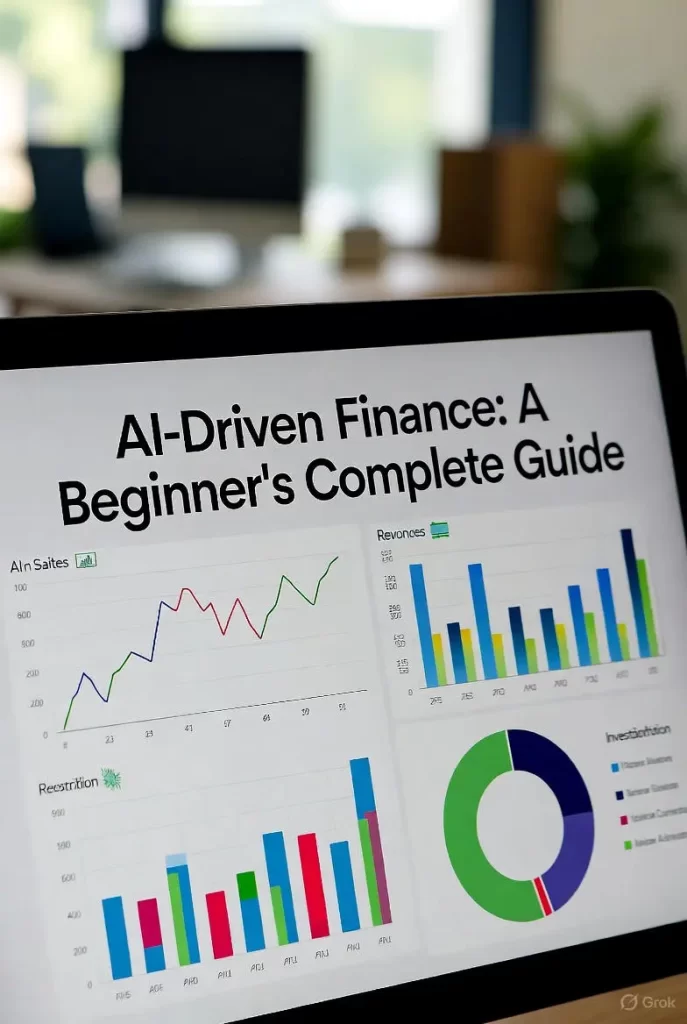
 Financial markets move fast — faster than any human can process.
Every second, millions of data points stream from stock exchanges, social media, corporate earnings reports, and global events. For decades, analysts tried to interpret this chaos manually, relying on charts, patterns, and experience. But today, Machine Learning (ML) has changed everything.
Machine learning models don’t just look at the past — they learn from it, detect hidden patterns, and even anticipate future market behavior. Whether predicting stock prices, assessing risk, or identifying trading opportunities, ML has become the brain behind modern financial intelligence.
In this article, we’ll explore how machine learning models analyze market trends — from data collection and model selection to interpretation and future predictions.
What Is Machine Learning in Finance?
Machine learning is a subset of Artificial Intelligence (AI) that enables computers to learn from data without being explicitly programmed.
In the world of finance, ML systems continuously analyze huge datasets — prices, volume, economic indicators, sentiment, and news — to find trends, correlations, and anomalies.
Why Machine Learning Matters in Market Analysis
- Massive Data Processing: ML can handle terabytes of historical and real-time market data far beyond human capacity.
- Pattern Recognition: It detects complex relationships invisible to traditional analysis.
- Automation: It executes trades or signals in milliseconds based on learned patterns.
- Adaptability: Models evolve with new data — they learn and improve continuously.
In short, machine learning allows analysts to turn data noise into financial intelligence
The Evolution of Market Analysis: From Charts to Algorithms
Traditional market analysis relied on technical indicators (moving averages, RSI, MACD) and fundamental data (earnings, revenue, P/E ratios). Analysts combined intuition with mathematical models.
But as markets globalized and data sources exploded, human analysis hit its limits.
Enter algorithmic trading — and eventually machine learning-driven strategies.
Timeline Snapshot
| Era | Method | Limitation |
| 1980s–1990s | Technical & fundamental analysis | Manual, time-consuming |
| 2000s | Algorithmic trading | Rule-based, rigid |
| 2010s–Now | Machine learning & AI | Adaptive, data-driven |
ML models don’t follow fixed rules — they learn from new market behavior, enabling traders and analysts to make smarter, faster, and more accurate decisions.
How Machine Learning Models Work: The Core Process
Let’s break down how ML actually analyzes market trends — step by step.
Step 1: Data Collection and Cleaning
ML models depend on high-quality data. Financial analysts feed the model with diverse datasets, including:
- Historical price data: open, close, high, low, volume
- Macroeconomic data: GDP growth, interest rates, inflation, unemployment
- Alternative data: social media sentiment, Google search trends, satellite imagery (for commodity demand)
- Corporate data: earnings reports, balance sheets, analyst calls
Before analysis, data undergoes cleaning and normalization — removing outliers, filling gaps, and aligning different time series formats.
Clean data = reliable predictions.
Step 2: Feature Engineering
“Features” are the measurable variables the model uses to make predictions.
For example:
- Daily price returns
- Moving averages (5-day, 20-day)
- Trading volume ratios
- Volatility indexes
- Sentiment scores from financial news
The goal is to help the model focus on meaningful signals rather than noise.
In finance, feature engineering is often more important than the model itself.
Step 3: Model Selection
There are several categories of ML models used in market trend analysis. Let’s look at the most common ones.
A. Supervised Learning Models
These models are trained on labeled data — where both inputs (features) and outputs (target values) are known.
Examples in finance:
- Predicting next-day stock prices (regression)
- Classifying whether a stock will go up or down (classification)
Popular algorithms:
- Linear/Logistic Regression
- Random Forests
- Gradient Boosted Trees (XGBoost, LightGBM)
- Support Vector Machines (SVM)
B. Unsupervised Learning Models
Used when there are no predefined outputs. These models detect hidden structures or relationships in data.
Examples:
- Grouping stocks with similar behaviors (clustering)
- Identifying unusual price activity (anomaly detection)
Popular algorithms:
- K-Means Clustering
- Principal Component Analysis (PCA)
- Autoencoders
C. Deep Learning Models
Deep Learning (DL) — using neural networks — has revolutionized financial forecasting.
Examples:
- Recurrent Neural Networks (RNNs) for time-series forecasting.
- Long Short-Term Memory (LSTM) networks that capture long-term dependencies in stock data.
- Transformer models (like those used in ChatGPT) for analyzing financial text or sentiment.
Deep learning models excel at recognizing nonlinear relationships — ideal for complex, unpredictable markets.
Step 4: Model Training
The model “learns” by analyzing historical data and adjusting its internal parameters to minimize prediction errors.
For instance:
- If a stock’s price pattern historically rises after strong earnings reports, the model will strengthen that connection.
- If similar signals lead to different results, the model learns to reduce its confidence.
This process repeats thousands of times using optimization techniques like gradient descent.
Step 5: Backtesting and Validation
Before deployment, models must prove their accuracy on unseen data.
Backtesting involves simulating past trades using historical data to evaluate performance metrics like:
- Accuracy & Precision
- Sharpe Ratio (risk-adjusted return)
- Maximum Drawdown
If the model performs consistently across different timeframes and markets, it’s ready for real-world use.
Step 6: Deployment & Continuous Learning
Once deployed, ML systems continuously monitor live market data.
They adapt their behavior automatically — learning from every new tick, headline, or economic event.
For example, during COVID-19, ML models quickly recalibrated after detecting increased volatility, helping traders adjust to a completely new market environment.
Types of Market Trends ML Can Detect
Machine learning models can uncover patterns across several financial dimensions:
1. Price Momentum:Detects when a stock or sector consistently moves upward or downward, indicating sustained buying or selling pressure.
2. Mean Reversion:Identifies assets likely to revert to their long-term averages — crucial for contrarian strategies.
3. Seasonal and Cyclical Patterns:Models detect recurring behaviors tied to seasons, quarters, or global events (e.g., Q4 spending surges).
4. Cross-Asset Relationships:ML can find correlations between oil prices, currencies, and equities that traditional methods miss.
5. Market Sentiment:By analyzing millions of tweets, articles, and financial reports, sentiment analysis models gauge investor mood in real-time.
6. Risk and Volatility Forecasting:ML predicts when volatility spikes are likely, allowing investors to hedge before the storm.
Key Tools and Technologies
Modern financial data scientists rely on a mix of open-source and enterprise tools:
| Category | Tools |
| Languages | Python, R |
| Libraries | Scikit-learn, TensorFlow, PyTorch, Keras, XGBoost |
| Data Sources | Bloomberg, Alpha Vantage, Quandl, Yahoo Finance, social APIs |
| Visualization | Tableau, Power BI, Plotly |
| Cloud Platforms | AWS SageMaker, Google Vertex AI, Azure ML |
These tools collectively power intelligent trading systems, research dashboards, and automated financial analytics.
Real-World Applications of ML in Market Analysis
1. Quantitative Trading:Firms like Renaissance Technologies and Two Sigma use ML to predict price movements and automate trades — generating billions in profit.
2. Portfolio Optimization:AI helps allocate assets dynamically based on changing correlations and risk profiles.
3. Risk Management:Machine learning models identify potential losses under different market scenarios faster than traditional VaR (Value at Risk) methods.
4. Sentiment-Based Investing:Hedge funds analyze news sentiment to predict short-term price shifts — for example, a positive tweet from Elon Musk can move crypto prices instantly.
5. Fraud and Anomaly Detection:Banks use ML to spot unusual transactions, insider trading, or manipulative patterns before they escalate.
Advantages of Using ML for Market Trend Analysis
- Speed: Real-time insights vs. human analysis delays.
- Objectivity: No emotional bias — decisions purely data-driven.
- Scalability: Can monitor thousands of assets simultaneously.
- Adaptability: Models evolve with new information.
- Early Signal Detection: Identify shifts before the broader market reacts.
Limitations and Challenges
Machine learning isn’t magic. It comes with challenges every investor and analyst should understand.
1. Data Quality:Garbage in, garbage out — poor or biased data leads to inaccurate predictions.
2. Overfitting:Models can “memorize” patterns in training data but fail in real markets.
That’s why cross-validation and regular retraining are vital.
3. Black Box Problem:Complex ML systems (especially deep learning) are often hard to interpret — even by their creators.
4. Market Randomness:No algorithm can predict black swan events like sudden geopolitical crises or pandemics.
5. Ethical and Regulatory Issues:Automated trading can exacerbate flash crashes, and regulators are still catching up with AI-driven finance.
The Future of ML in Market Trend Analysis
Machine learning in finance is still evolving — rapidly. The next frontier includes:
1. Explainable AI (XAI):Future ML models will provide transparent reasoning behind predictions, increasing trust and accountability.
2. Reinforcement Learning:This advanced ML method “learns by doing,” adapting strategies dynamically in simulated environments — ideal for algorithmic trading.
3. Quantum Machine Learning:Combining quantum computing with ML will allow analysis of exponentially more data in real-time — revolutionizing risk forecasting.
4. AI + Blockchain Integration:Hybrid systems could bring transparent, tamper-proof AI-driven analysis for decentralized finance (DeFi) markets.
5. Human-AI Collaboration:Analysts will act as interpreters and strategists, while ML handles heavy computation — a perfect symbiosis.
Conclusion
Machine learning has redefined how we understand and predict market behavior. What once took teams of analysts weeks can now be done in seconds — with greater accuracy and insight.
From processing real-time market feeds to uncovering hidden correlations, ML transforms raw data into actionable intelligence. Yet, while machines excel at detecting patterns, human judgment remains essential for interpreting context and managing risk.
The future of market trend analysis isn’t human vs. machine — it’s human + machine.
Together, they form a partnership that’s faster, smarter, and more adaptive than ever before — paving the way for the next generation of financial intelligence.